Unified Endpoint Security: How UEM Protects and Stays Protected?

IT teams use a range of tools and risk-management practices to protect IT infrastructure from malware, ransomware, AI-assisted phishing, and supply chain attacks. Firewalls, antivirus, backups, and user awareness training are solid starting points. Unified Endpoint Management (UEM) provides additional protection. But how can you ensure your UEM solution remains secure?
What should I look for in a secure UEM solution?
A secure UEM solution starts with fit, with capabilities that meet your organization's specific needs. The focus should be on secure UEM operation and endpoint
security best practices, not on feature lists.
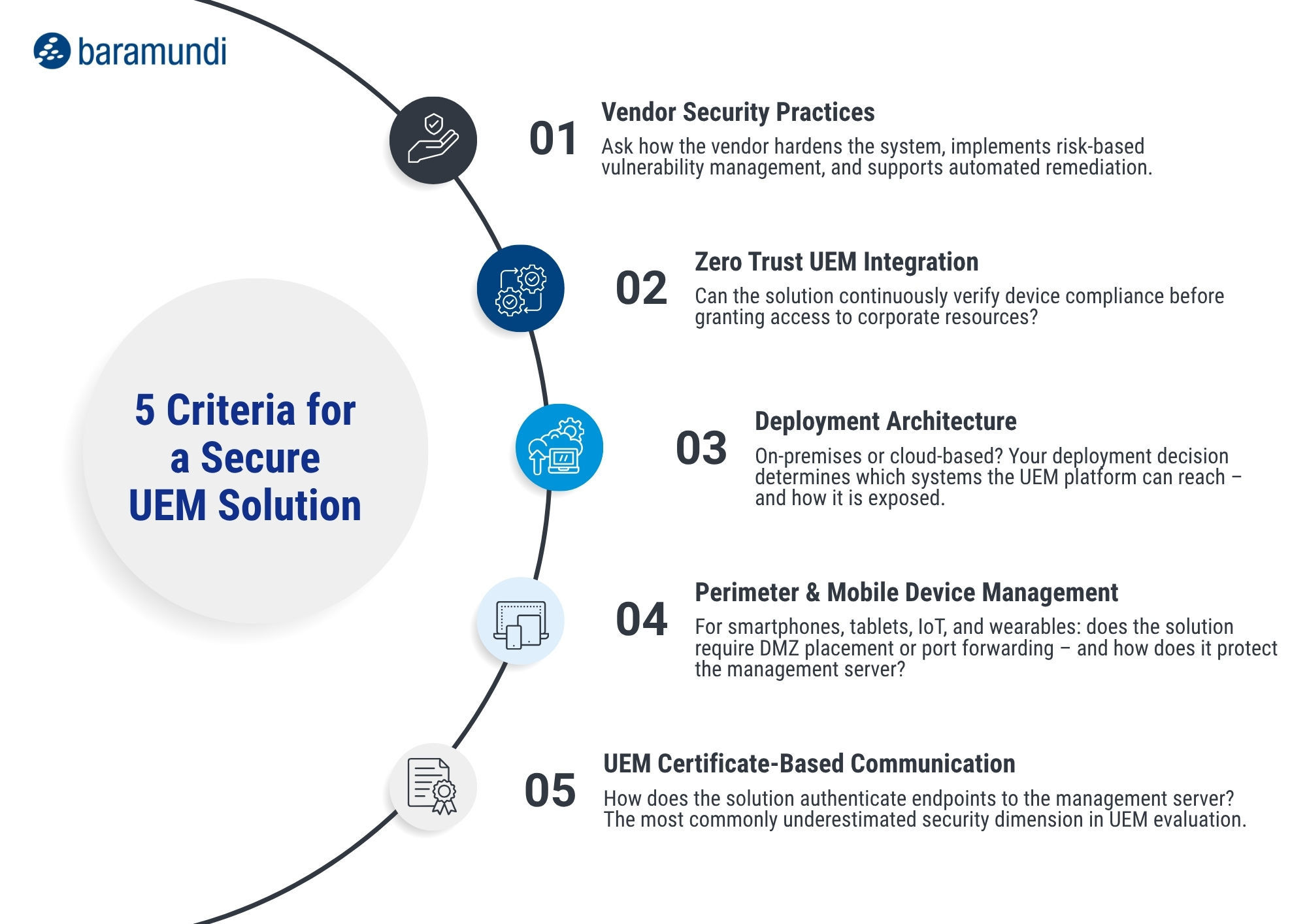
Practical evaluation checklist:
- Vendor security practices and risk-based vulnerability management: How does the vendor harden the system, implement risk-based vulnerability management, and support automated remediation?
- Zero Trust UEM integration: Can the solution continuously verify device compliance before granting access to corporate resources?
- Deployment architecture: Decide early between on-premises and cloud-based deployment to determine which systems the UEM platform can reach and how it will reach them.
- Mobile device and perimeter management: For smartphones, tablets, wearables, and similar devices, determine whether the system requires DMZ placement or direct port forwarding.
- UEM certificate-based communication: How does the solution authenticate endpoints to the management server? This is the most commonly underestimated security dimension in UEM evaluations.
What is Unified Endpoint Management security?
Unified Endpoint Management (UEM) security encompasses both protecting the UEM platform and using it to enforce endpoint security policies. It covers secure server operations, certificate-based communication, role-based access control, and audit-ready logging to ensure that only authorized systems manage devices and to maintain compliance with regulations such as the DSGVO, NIS2, and DORA in the EU, and with HIPAA, PCI, and CCPR in the U.S.
Why is secure operation of a UEM solution so critical?
A UEM solution is used to set and manage comprehensive infrastructure security measures, making it one of the most powerful and security-critical IT
management systems. It holds the highest administrative privileges, has direct access to connected Active Directories, and automatically issues certificates
through connected certificate authorities. Anyone who gains control of the system can control the entire network, making Endpoint Security Management at the UEM
level a non-negotiable priority.
The core risk: privileged access without adequate protection
UEM systems are prime targets for cyberattacks because they hold the highest administrative privileges across the entire endpoint estate. An attacker who compromises the management server
can control the entire network without touching individual endpoints. This is why secure UEM operation is a prerequisite for any meaningful UEM cybersecurity strategy.
Why standard TLS is not enough
TLS encryption alone – the same used for HTTPS browsing – is necessary but insufficient. In standard HTTPS, only the server is authenticated by a certificate; the client is not. In a UEM
environment, mutual certificate authentication is essential. Both the server and the endpoint must uniquely identify each other; otherwise, an attacker can impersonate or
register cloned endpoints, even with compromised credentials.
What fully secure UEM communication requires
Fully trustworthy communication – where neither side accepts an unverified counterpart – requires UEM certificate-based communication with properties such as mutual authentication, message integrity, protection against endpoint impersonation, certificate pinning, and more. This technical foundation separates a securely operated UEM from one that merely appears secure.
Secure communication: the technical baseline for UEM endpoint security
The following features define the communication security of a modern Endpoint Security Management solution and align with endpoint security best practices:
- Certificate strength: Minimum 2048-bit key length and SHA-2 hash algorithm as a baseline; many environments today already use 3072-bit or EC-based keys with SHA-256 or stronger.
- TLS version enforcement: TLS 1.0 and 1.1 must be disabled. TLS 1.2 with strong cipher suites is the minimum; TLS 1.3 is recommended, especially in Zero Trust UEM environments and regulated industries.
- Server-side certificate pinning: Managed endpoints are pinned server-side; access is controlled via explicit allow lists.
- Client-side server certificate pinning: The endpoint verifies the server's certificate to prevent man-in-the-middle attacks.
- Message integrity checks: Incoming messages are verified using digital signatures.
- Certificate lifecycle management: Simple, reliable replacement of corrupted or expired certificates.
- Consistent implementation: All of the above applied uniformly across all managed endpoint types – mobile, desktop, IoT, and wearable.
Access control and logging: governance for high-privilege UEM systems
Because UEM systems hold elevated privileges over endpoints and identities, administrative access must follow endpoint security best practices for governance:
- Role-based access control (RBAC) with least-privilege principles
- Separation of duties between configuration, deployment, and audit roles
- Audit logs for all configuration changes and administrative actions – enabling full traceability
All configuration changes and administrative actions should be recorded in audit logs, enabling traceability and supporting compliance with regulatory frameworks such as NIS2, DORA, and DSGVO.
Regulatory compliance through secure UEM: NIS2, DORA, and DSGVO
A securely operated UEM platform provides the technical infrastructure for UEM cybersecurity compliance:
- Consistent security controls across all managed endpoints
- Audit-ready logging that satisfies applicable documentation requirements
- Centralized compliance reporting that gives IT leaders and auditors a clear, verifiable view
ISO 27001 UEM certification – as held by the baramundi Management Suite – provides additional assurance: it demonstrates that the solution's design and operational processes have been independently validated against established information security management standards.
How does UEM support Zero Trust?
Zero Trust UEM treats every device as untrusted by default and grants access to corporate resources only after continuous verification of device compliance. A modern UEM solution supports this by continuously checking:
- Patch status and vulnerability exposure
- Active EDR protection
- Enabled encryption (e.g., BitLocker or FileVault)
These compliance signals feed directly into access decisions: only verified, compliant endpoints are permitted or prioritized for access. In this way, UEM serves as an enforcement layer between identity-based access policies and endpoints – a core component of any Endpoint Security Management strategy.
Proactive endpoint management: from visibility to action
DEX monitoring provides what reactive IT support cannot: visibility into endpoint health before users are
affected. By continuously measuring performance indicators (boot times, CPU and RAM utilization, crash rates, etc.), IT teams can identify devices with deteriorating performance
early and act before productivity declines.
Visibility alone is not enough, however. Modern UEM endpoint security closes the loop: performance insights trigger targeted remediation, either automated or initiated by
an admin, to reduce unplanned downtime and keep endpoints consistently secure and functional.
Conclusion: Endpoint Security Management as an organizational imperative
Unified Endpoint Security is much more than a single product feature. It is a strategic posture. A securely operated UEM solution minimizes attack surfaces at the management level, enforces Zero Trust-aligned device compliance checks, supports regulatory requirements, and improves the digital employee experience across the organization.